

Starting your trading journey can feel exciting. You learn about charts, currency pairs, technical analysis, indicators, support and resistance, and then comes one important question, should you start with a demo account or open a live trading account?
For most beginners, the answer is simple: start with a demo account first. But that does not mean you should stay on demo forever.
A demo account gives you a safe environment to learn how trading platforms work, practise placing orders, test trading strategies, and understand how your decisions affect a trading account without putting real money at risk.
A live account, on the other hand, introduces something a demo account cannot fully reproduce: real financial consequences and real emotional pressure. That difference can completely change the way a trader behaves.
In this guide, we will compare demo accounts vs live accounts, explain their advantages and disadvantages, look at the differences in trading psychology, execution, costs and risk, and help you understand when you may be ready to move from demo trading to live trading.
What Do You Mean By Demo Trading Account?
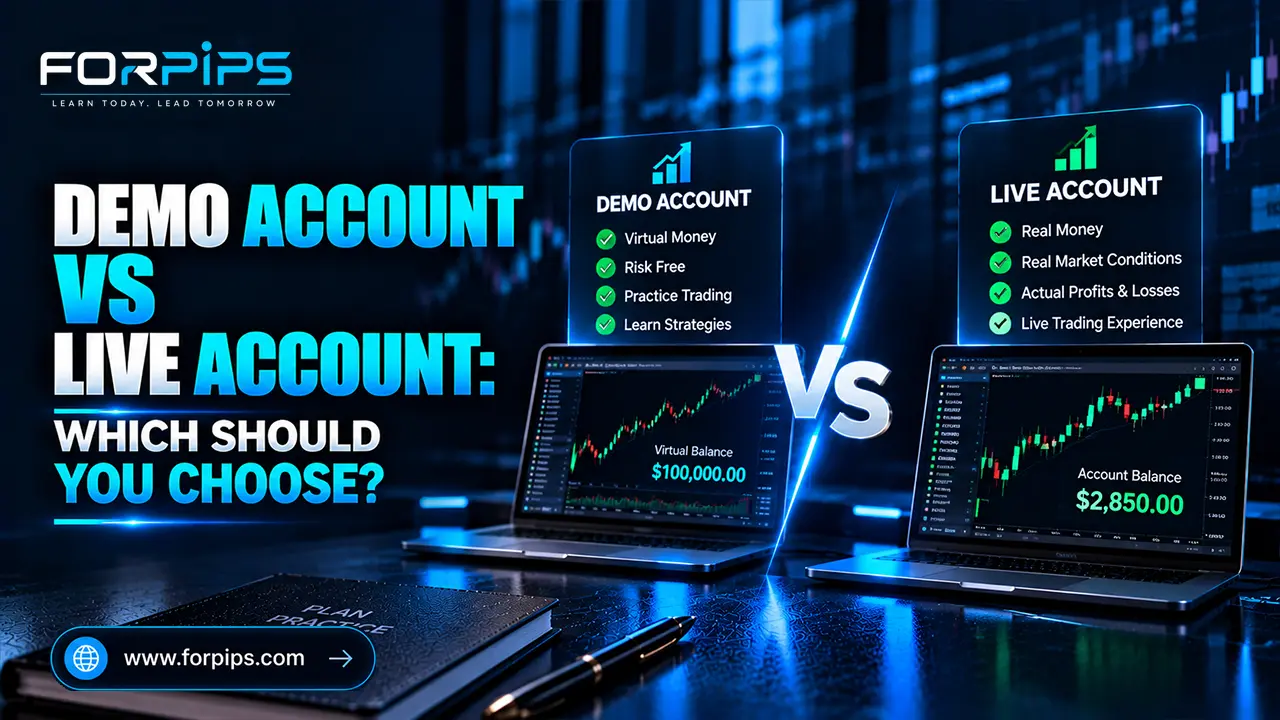
A demo trading account is a practice account that allows you to trade using virtual funds instead of your actual money.
The platform usually gives you simulated funds that you can use to place buy and sell orders. Depending on the broker and platform, you may have access to charts, indicators, order types and other trading tools.
The purpose is not to make you rich with virtual money. The real purpose is to learn how trading works.
Because the money is virtual, a losing trade does not take money from your bank account. That makes the demo account particularly useful for beginners.
What Do You Mean By a Live Trading Account?
A live trading account is an account funded with real money that allows you to participate in the financial market under the broker’s applicable trading conditions.
When you open a live trade, your capital is actually exposed to market movements. If the trade moves in your favour, you may make a profit. If the trade moves against you, you may lose money. This is where trading becomes very different from practising.
Imagine you made ten successful trades on a demo account. You may feel confident that you understand your strategy.
Why is a Demo Account Useful for Beginners?
The first goal of a beginner should not be making money, the first goal should be learning how the market and trading platform work. A demo account gives you an environment where you can build those basic skills.
You can learn how to read price charts, understand currency pairs, place different types of orders and monitor open positions. It also gives you an opportunity to understand important trading concepts such as spreads, leverage, margin, stop-losses, take-profit orders and position sizing.
These concepts may sound simple when you read about them, but using them on an actual trading platform is different. Practising them repeatedly can help you become more comfortable before you consider risking real money.
Should You Keep Using a Demo Account After Going Live?
Yes, and there is a good reason to do so, a demo account can remain useful even after you open a live account. For example, imagine you have a strategy that you already use successfully in your live account. You suddenly discover a new indicator or trading setup that you want to test.
Instead of immediately using the new idea with real money, you can test it on a demo first. This creates a useful separation, live account for your established trading plan. Demo accounts for experimentation and learning. This approach can help prevent unnecessary experimentation with real capital.
How to Choose a Broker Before Opening a Live Account?
Choosing a broker is another important step when moving from demo to live trading.
Do not choose a broker simply because it promises high returns or advertises extremely high leverage. Instead, research the broker’s regulatory status, trading conditions, fees, available instruments, and withdrawal procedures.
You should pay attention to the total cost of trading, depending on the account and instrument, this can include spreads, commissions and overnight financing or other charges.
You should also check whether the broker is authorised to provide services in your jurisdiction. Regulators have repeatedly warned consumers about unauthorised forex firms and scams involving unrealistic or guaranteed profit claims.
What are the Common Mistakes Beginners Make With Demo Accounts?
One of the biggest mistakes is treating demo trading like a game. Because the money is virtual, some traders take risks they would never take with their own money.
Another mistake is focusing entirely on profit, a demo account showing a large profit may look impressive, but it does not tell you whether you followed a sensible process.
Some beginners also switch strategies too frequently, they use one strategy for a few trades, experience a loss and immediately move to something else. A better approach is to learn one method properly, test it carefully and understand its strengths and weaknesses.
What are the Common Mistakes Beginners Make After Going Live?
Moving to a live account can introduce a different set of problems. Some traders become too cautious and stop taking valid setups because they are afraid of losing, while some others become too aggressive because they want to make back losses quickly.
Another common mistake is increasing position size after a winning streak. Several profitable trades can create overconfidence, which may lead to unnecessary risk.
The key is to remember that your strategy does not suddenly become better because you had three winning trades, and it does not necessarily become useless because you had three losing trades.
Additionally, consistency comes from following a process rather than reacting to every individual result.
Demo Account vs Live Account: Pros and Cons
A demo account is excellent for learning because it allows you to practise without directly risking your capital. It is useful for understanding the trading platform, testing strategies and developing basic trading habits.
Its main limitation is that virtual money does not create the same emotional pressure as real money. Depending on the broker, demo conditions may also differ from live execution.
A live account gives you real trading exposure because every decision has a real financial consequence, it can teach you valuable lessons about discipline, emotions and risk.
That is why beginners should generally avoid treating a live account as their first classroom.
Final Verdict: Should You Start With a Demo or Live Account?
For most beginners, starting with a demo account is the more sensible choice, it gives you the opportunity to understand the market, learn the trading platform and practise your strategy without investing real money.
But do not measure your demo success only by virtual profits, measure it by your discipline, consistency, risk management and ability to follow a trading plan.
When you eventually move to a live account, start carefully, use only money you can afford to lose, keep your position sizes manageable and remember that your first live trades are another stage of your education.
The goal of trading is not to win every trade. The goal is to develop a process that helps you make informed decisions, manage risk and learn from both winning and losing trades.
Demo trading teaches you how to trade. Live trading teaches you how you behave when trading matters. Using both wisely can give beginners a much stronger foundation for their trading journey.
Also read – GTCFX IB Commission: A Complete Guide to the Introducing Broker Program
Frequently Asked Questions About Demo and Live Trading Accounts
Question. Is a demo account better than a live account for beginners?
Answer. For someone who is completely new to trading, a demo account is a better starting point because it allows them to learn and practise without directly risking real capital.
Question. Can I make real money with a demo account?
Answer. No, demo accounts use virtual funds any profits displayed in the account are simulated and cannot normally be withdrawn as real trading profits.
Question. Is demo trading exactly the same as live trading?
Answer. No, although a demo account can provide a useful simulation of trading, live markets can involve real execution conditions, changing spreads, liquidity and slippage. Some brokers also state that demo conditions may not completely reproduce live trading conditions.
Question. How long should I practise on a demo account?
Answer. There is no fixed period that applies to everyone. Instead, focus on whether you understand your strategy, risk management and trading platform and can follow your trading rules consistently.
Question. When should I move from demo to live trading?
Answer. You may consider the transition when you understand your strategy, have practised it consistently, understand the risks involved and can afford to lose the money you plan to trade.
Question. Can I use a demo account after opening a live account?
Answer. Yes a demo account can remain useful for testing new strategies, indicators or trading ideas before applying them to your live account.
Question. Why do traders behave differently on demo and live accounts?
Answer. The main reason is emotional pressure, virtual money does not carry the same financial consequences as real money, so fear, greed and anxiety may become much stronger when a trader moves to a live account.
Question. Is live forex trading risky?
Answer. Yes, forex trading involves market risk, and leverage can significantly increase both potential gains and potential losses. Additionally, beginners should understand these risks before trading with real money.
Question. Should I start with a large live account after demo trading?
Answer. Not necessarily, moving from demo to live does not mean you need to start with a large amount. If you decide to trade live, using an amount you can afford to lose and keeping your position size appropriate to your risk tolerance can help you manage the transition.
Question. What should I learn before opening a live trading account?
Answer. You should understand the basics of the market you want to trade, how your trading platform works, order types, spreads, leverage, margin, position sizing, stop-losses, trading costs and risk management.