

If you are new to forex trading, you may have noticed that every currency pair has two prices and you may be thinking why are there two prices? And what does the small difference between them mean? That difference is called the forex spread.
Understanding the spread is one of the first things every beginner should learn because it is closely connected to the cost of entering and exiting a forex trade. The spread can also change depending on market liquidity, volatility, trading sessions, and important economic news.
In this guide, we will explain what forex spread is, how forex spreads work, how to calculate the spread, what a pip means, the difference between tight and wide spreads, fixed and variable spreads, and how spreads can affect different trading styles. Let’s start with the basics.
What is Spread in Forex ?
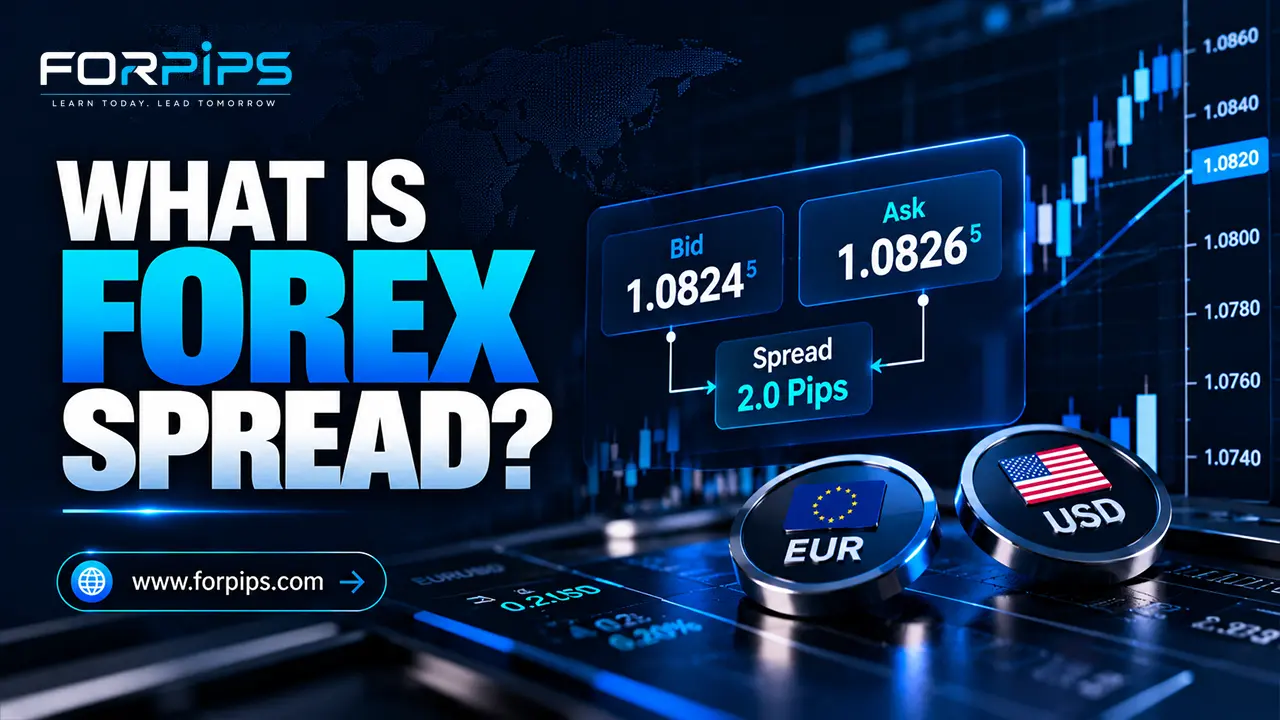
A forex spread is the difference between the bid price and the ask price of a currency pair. In simple words, the spread is the small gap between the price at which you can sell and the price at which you can buy a currency pair.
The spread is commonly treated as a trading cost built into the quoted buy and sell prices. The actual cost of a spread depends on the spread size and the position size you trade.
Why Does the Forex Spread Exist?
Forex is a global, decentralised market where prices are provided through a network of banks, financial institutions, liquidity providers, brokers, and others.
The difference between the bid and ask prices helps reflect the cost and conditions of providing liquidity and executing trades.
For a beginner, the easiest way to remember it is: Spread is the difference between the bid price and ask price.
How Does Spread in Forex Work?
A forex spread is the difference between the buying price and selling price of a currency pair. It is one of the main costs of trading forex. For example, if EUR/USD has a buying price of 1.1002 and a selling price of 1.1000, the spread is 0.0002, or 2 pips.
When a trader opens a trade, they usually start with a small loss because of this difference, the trader needs the market price to move enough to cover the spread before making a profit. In simple words, the spread is the small difference between the price you buy and sell a currency for.
What Do You Mean By a Fixed Spread in Forex Trading?
A fixed spread stays at a predetermined level or within defined conditions rather than continuously changing with normal market conditions. For example, a broker might quote a fixed spread of 2 pips for a particular currency pair under its stated conditions.
The main attraction is predictability. However, traders should not assume that a fixed spread is automatically cheaper, the overall trading cost depends on the broker’s pricing structure and any additional charges.
What Do You Mean By a Variable Spread?
A variable spread, also known as floating spread, changes according to market conditions. The spread may become smaller when liquidity is strong and market conditions are relatively stable. It may become wider during periods of high volatility, lower liquidity, or major economic announcements.
Variable spreads are common in forex trading, and the exact pricing depends on the broker and account.
Why is Spread Important in Forex?
The spread matters because it is part of the cost of entering and exiting a trade, imagine two traders make exactly the same number of trades and use the same position size. If one consistently pays a larger spread, that trader may have higher transaction costs.
This becomes particularly important for traders who open many positions or aim to capture relatively small price movements. Additionally, spread costs can have different importance depending on whether someone is day trading, swing trading, or holding positions for longer periods.
How Can Beginners Manage Forex Spread Costs?
You cannot completely remove the spread from a trade, but you can learn how it works and include it in your trading plan.
1. Know Your Broker’s Pricing
Always read the broker’s pricing about spreads, commissions, swaps and other charges, so that you can decide your commission easily.
2. Check the Spread Before Trading
Look at the current bid and ask prices before opening a position, as it is essential in saving your pocket.
3. Be Careful During Major News
Economic announcements can create fast price movements and changing spreads, so always pay attention to economic news and other information that can influence the forex market.
4. Understand Your Trading Strategy
If your strategy targets very small price movements, spread can become a more significant part of the trade.
5. Consider the Full Trading Cost
A low advertised spread does not tell the whole story if a separate commission or other cost applies.
6. Practise on a Demo Account
A demo account can help beginners understand how spreads appear in real time quotes without immediately putting real capital at risk.
What Do You Mean By a Good Forex Spread?
There is no single spread that can be called good for every currency pair, account, strategy, or market condition. A spread should be considered in context.
For example, a spread that may be reasonable for a longer-term strategy could be more significant for a scalping strategy that targets small price movements.
Also Explore – How Forex IB Commission Works?
Frequently Asked Questions About Spread in Forex Trading
Question. What is a spread in forex?
Answer. A forex spread is the difference between the bid price and ask price of a currency pair. It is commonly measured in pips and represents part of the cost of trading.
Question. How do you calculate forex spread?
You can easily calculate spread by using this simple formula: Spread = Ask Price − Bid Price
Question. What is a tight spread in forex?
Answer. A tight spread means there is a small difference between the bid and ask prices, the spread based trading cost is therefore smaller for the same position size.
Question. What is a wide spread in forex?
Answer. A wide spread means there is a larger difference between the bid and ask prices, wide spreads can occur during periods of high volatility or lower liquidity.
Question. Why does the forex spread change?
Answer. Variable spreads can change because of market liquidity, volatility, economic news, trading activity, currency pair and other market conditions.
Question. Is a lower forex spread always better?
Answer. A lower spread can reduce the spread component of trading costs, but it should not be considered separately from commissions and other applicable charges. The total cost depends on the complete pricing structure.
Question. Does spread affect forex profit?
Answer. Yes, the spread is part of the cost of entering and exiting a trade. The effect can be more noticeable for strategies that target small price movements or involve frequent trading.
Question. What is the difference between spread and commission?
Answer. The spread is the difference between the bid and ask prices. While a commission is a separate fee that a broker may charge, some account structures use a combination of spreads and commissions.
Question. Can forex spreads widen during news?
Answer. Yes, major economic announcements and sudden market volatility can lead to wider spreads as market conditions and liquidity change.
Question. What should beginners know about forex spreads?
Answer. Beginners should learn how to read bid and ask prices, calculate the spread in pips, understand how position size affects the cost, and check the broker’s complete pricing structure before trading.