

If you are new to forex trading, you may have heard terms like market structure, liquidity, and market makers. At first, these concepts can sound hard to understand. But once you learn how the forex market is organized and how orders move through it, trading concepts become much easier to understand.
The forex market is not just about buying one currency and selling another, it is a global network where banks, financial institutions, corporations, governments, brokers, professional traders, and retail traders exchange currencies.
Now, by understanding how the forex market works can help you make better trading decisions and understand why prices move. Lets move to our next topic which is about forex market structure.
What Do You Mean By Forex Market Structure?
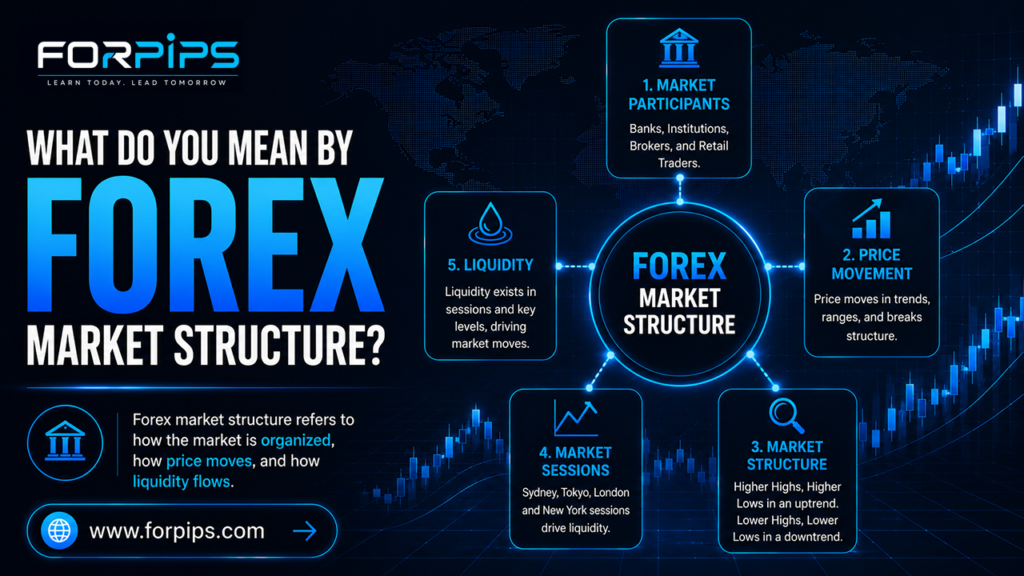
Forex market structure is a way the foreign exchange market is organized and how different participants interact with one another. As compared to other traditional stock exchanges, forex does not operate through one central exchange.
Instead, it is a decentralized market, meaning currency transactions take place through a global network of banks, financial institutions, brokers, and other participants.
The forex market operates almost 24 hours a day, five days a week, across major financial centers across the globe with more than 9 major forex trading sessions.
How Is the Forex Market Structured?
You can think of the forex market as a network of connected participants, not as one single marketplace. At the institutional level, large banks and financial institutions trade currencies with one another, these institutions provide liquidity and facilitate transactions for other participants.
Below them are brokers and other financial intermediaries that provide retail traders with access to the forex market. Here is a simplified structure looks like this:
Central Banks & Governments → Large Banks & Institutions → Liquidity Providers/Brokers → Retail Traders
This is a simplified representation as it helps participants interact in different ways. Understanding this structure is important because different participants have different objectives, trading sizes, and levels of influence.
What Are Forex Market Mechanics?
Market mechanics describe how buying and selling actually takes place and how orders contribute to price movements. Whenever someone wants to buy a currency pair, there must be a seller willing to take the other side of the transaction. The interaction between buyers and sellers helps determine the available market price.
For example, consider EUR/USD. If you believe the euro will become stronger against the US dollar, you may buy EUR/USD. If another trader expects the euro to weaken, they may sell EUR/USD. When buying and selling changes, the market price can change.
How Do Orders Affect the Market?
There are lots of types of orders can be used by a Forex traders, such as:
1. Market Orders
A market order attempts to buy or sell at the best price available right now. For example, if EUR/USD is trading around 1.1000 and you place a market buy order, your trade may be executed around the available price at that moment.
2. Limit Orders
A limit order is placed at a specific price or better. For example, if EUR/USD is currently trading at 1.1000 but you want to buy at 1.0950, you could place a buy limit order around that level.
3. Stop Orders
A stop order becomes active when the market reaches a specified price. Traders commonly use stop orders for entries or to manage risk. The interaction of these orders contributes to the continuous process of price discovery.
What Is Liquidity in Forex?
Liquidity refers to how easily an asset can be bought or sold without causing a significant change in its price. The forex market is generally considered one of the world’s most liquid financial markets as major currency pairs such as EUR/USD, GBP/USD, and USD/JPY usually have significant trading activity.
Let’s understand with a simple example of liquidity; Imagine a market where thousands of buyers and sellers are seeking to trade an asset. If you want to buy, there may be plenty of sellers available. If you want to sell, there may be plenty of buyers available. This is a liquid market.
Now imagine a market with very few buyers and sellers. Executing a large order may cause the price to move substantially. That market would have lower liquidity.
What are the Key Takeaways for Beginners?
If you are seeking to start your career in forex trading, here are a few essential things to remember.
- Market Structure
Forex is a decentralized global market made up of different participants and liquidity venues.
- Market Mechanics
Market mechanics refers to prices change through the interaction of orders, liquidity, supply, demand, and market expectations.
- Major Participants
Central banks, commercial banks, investment firms, corporations, governments, brokers, and retail traders all participate in the forex ecosystem.
- Liquidity
Liquidity describes how easily transactions can take place without significantly affecting price. It can influence spreads, execution, and volatility.
- Market Makers
Market makers provide buy and sell quotes and help facilitate trading by supplying liquidity, while managing their own market and inventory risks.
Now, we have understood in detail about market structure, mechanics, participants, liquidity, and many more. If you are a new and want to explore more about Forex Trading you can simply visit our link so that we can help you with this.
Final Thoughts
Understanding forex market structure, market mechanics, major participants, liquidity, and market makers gives beginners a clearer picture of what happens behind the charts. Forex trading is not simply about identifying a buy or sell signal. Behind every price movement is a complex interaction between participants, orders, liquidity, economic information, expectations, and risk.
Once you understand these fundamentals concepts such as price action, market structure, liquidity zones, spreads, order execution, and institutional trading become much easier to understand. However, knowledge of market structure alone does not guarantee profitable trading, forex trading involves significant risk, and beginners should focus on education, proper risk management, and disciplined decision-making before taking real trade.