

Forex trading is not just buying or selling stocks at the right time, it is also about protecting your money from losses. This is where the term risk management in forex trading becomes important to understand, as good risk management can help traders control potential losses and protect their pocket.
Let’s understand with an example, suppose you are riding a bicycle, you may know how to move fast, but you also need brakes. Risk management works like the brakes in trading, it does not guarantee that every trade will be successful, but it can help you control how much you may lose when a trade goes against you.
For beginners, four important parts of risk management such as, position sizing, stop loss, risk to reward ratio, and capital management. Let’s understand each one in simple and quick language.
What Do You Mean By Risk Management in Forex Trading?
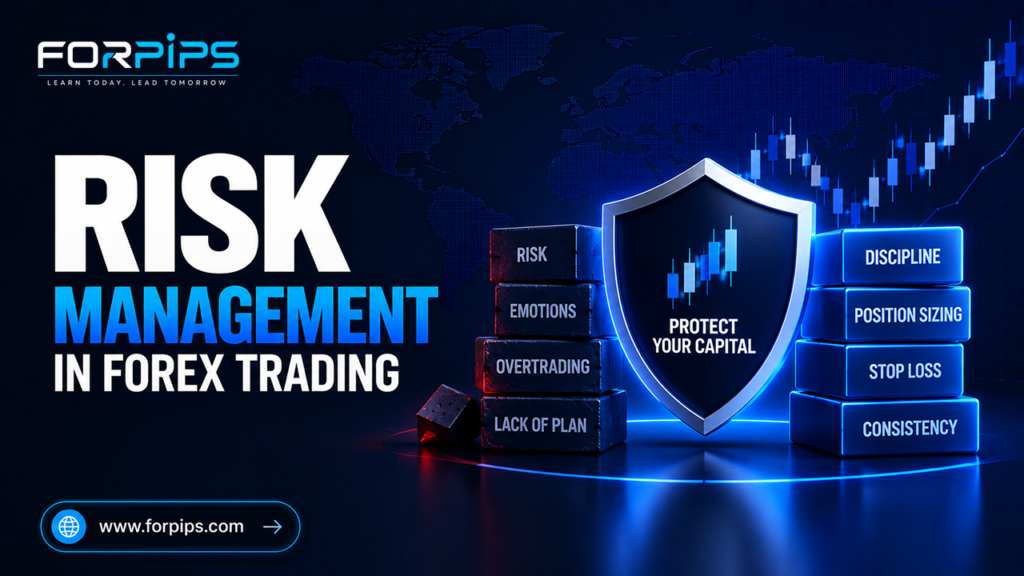
In simple language risk management is a strategy which is used to control the amount of money you could lose in a trade or across your trading account. The forex market can move quickly, even if your analysis looks correct, the market can suddenly move in the opposite direction.
A risk management plan helps you answer important questions before placing a trade, such as how much money you should risk on a single trade and how large your position should be.
It also helps you determine where to place your stop-loss, how much you could potentially lose, and whether the potential reward is worth taking the risk.
Most importantly, it helps you decide how much of your total trading capital you should use for each trade so that your risk remains controlled and manageable.
What Is Position Sizing in Forex?
Position sizing means deciding how much of a currency pair you should trade, and it is one of the most important parts of forex risk management. Many beginners make the mistake of choosing a trade size first and thinking about the risk later on.
A better approach is to decide how much money you are willing to risk on a trade and then calculate the appropriate position size. For example, imagine you have a $1,000 trading account and decide that you do not want to risk more than 1% of your account on a single trade. Since 1% of $500 is $5, your planned maximum loss for that trade would be $5.
You then choose your position size based on your entry price, stop-loss distance, and the currency pair. Since the stop-loss distance can be different for each trade, your position size may also be different each time.
What Is a Stop Loss?
A stop loss is an order that automatically closes a trade when the price reaches a certain level, its main purpose is to help limit your potential loss and protect your trading account from higher losses.
For example, suppose you buy EUR/USD because you think the price will go up, you decide that if the price falls to a certain level, your trading idea is no longer valid. You can place a stop-loss order at that level.
If the market reaches the stop-loss price, your trade may close automatically, depending on market conditions and execution. Using a stop loss can help you manage risk, and stay disciplined while taking trade. Additionally, it is important to choose the stop-loss level carefully based on your trading strategy and market conditions.
Why Is Stop Loss Important?
A stop loss can help prevent a small losing trade from turning into a much larger loss, it can also help traders avoid making emotional decisions. Without a clear plan, a trader may think the price will probably come back. However, the market may continue moving in the opposite direction and increase the loss. A predefined stop loss gives the trader a clear risk limit and helps them follow their trading plan instead of making decisions based on emotions.
What are the Common Risk Management Mistakes Needed to Avoid?
Beginners often make avoidable mistakes when managing trading risk.
1. Focusing Too Much on One Trade
A large position can create a large loss if the market moves against you, so always choose multiple trades.
2. Moving the Stop Loss
Some traders move their stop loss farther away because they do not want to accept a loss. This can turn a controlled loss into a much larger one.
3. Ignoring Position Size
Using the same large position size on every trade can create different levels of risk, always choose different.
4. Utilising Excessive Money
Forex trading involves significant financial risk. Trading capital should not be money needed for essential expenses.
5. Overtrading After a Loss
Trying to quickly recover a loss can lead to emotional decisions and even larger losses.
Also read – https://www.forpips.com/blog/what-is-gtcfx/
Final Thoughts
Risk management in forex trading is one of the most important skills a beginner can learn as risk management helps you decide how much you are willing to risk.
Understanding position sizing, stop loss, risk-to-reward, and capital management can help you approach trading in a more disciplined way.
Remember, the goal is not to avoid losing every trade, losing trades are part of trading. The goal is to control potential losses, and protect your capital.
Learn the basics, practice with a demo account, keep your risk under control, and never trade more money than you can afford to lose.
Frequently Asked Questions?
Question. What is risk management in forex trading?
Answer. Risk management is the process of controlling potential losses while trading forex, it includes choosing an appropriate position size, using stop loss, managing capital, and planning the risk-to-reward ratio.
Question. What is position sizing in forex?
Answer. Position sizing means deciding how large a trade should be based on factors such as account size, planned risk, and the value of the currency pair.
Question. Why is a stop loss important in forex trading?
Answer. A stop loss can help limit a potential loss by closing a trade when the market reaches a specific level. It can also help traders follow their risk plan instead of making emotional decisions.
Question. What is a good risk-to-reward ratio?
Answer. There is no single risk-to-reward ratio that is best for every trading strategy, traders should consider their strategy, market conditions, and overall risk plan.
Question. How much should a beginner risk per forex trade?
Answer. There is no universal amount that is suitable for everyone. Some traders use a small percentage of their account per trade, such as 1%, but the appropriate level depends on individual experience, strategy, and risk management.
Question. What is capital management in forex trading?
Answer. Capital management means managing your overall trading funds responsibly. It includes controlling position sizes, limiting potential losses, avoiding and excessive trading.
Question. Can risk management guarantee profits?
Answer. No, risk management cannot guarantee profits or prevent all losses. Its purpose is to help control potential losses and protect trading capital.