

Choosing the right trading platform can feel confusing when you are just starting your trading journey. If you have searched for forex trading platforms, you have probably come across two familiar names: MetaTrader 4 (MT4) and MetaTrader 5 (MT5).
Both platforms are developed by MetaQuotes and are widely used for financial market trading. MT4 is strongly associated with forex trading, on the other hand MT5 was designed as a broader multi asset platform supporting markets such as forex, stocks, futures and other instruments.
But which one is better for beginners? The answer depends on what you want to trade, the tools you need, your trading style, and the broker account available to you.
In this guide, we will explain MetaTrader 4 vs MetaTrader 5 in simple language so you can understand their differences and choose the platform that fits your needs.
What Is MetaTrader?
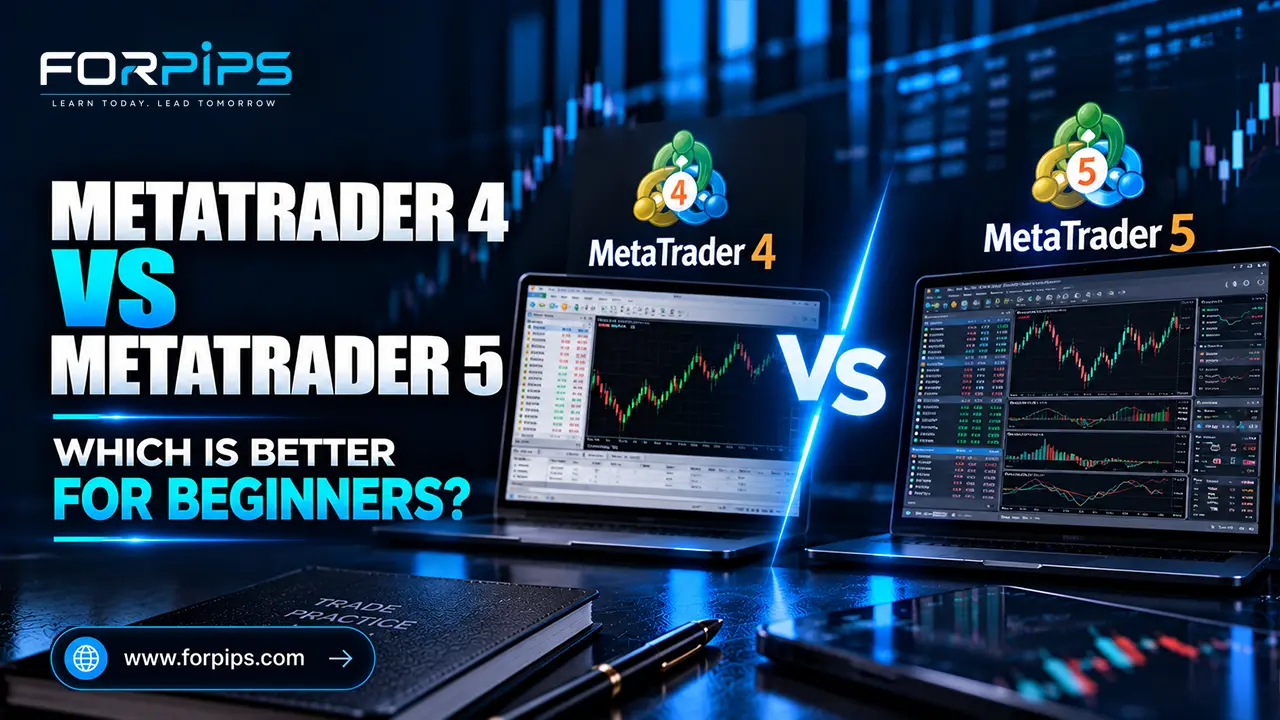
MetaTrader is a trading platform that allows traders to view market prices, analyse charts, place trades, manage positions and use automated trading tools. The two well known versions are:
- MetaTrader 4 (MT4)
- MetaTrader 5 (MT5)
Although their names look similar, they are not simply two versions of exactly the same platform.
MT4 was built primarily around forex trading. MT5 is a newer, multi asset platform designed to support a wider range of financial markets and provide more advanced analytical and trading features.
For beginners, both platforms can provide the basic tools needed to learn chart analysis and trading. The important question is which platform better matches your goals.
What Do You Mean By MetaTrader 4?
MetaTrader 4, commonly called MT4, is a popular trading platform primarily associated with forex trading. It provides tools for analysing currency prices, opening and managing trades, using indicators, creating charts and running Expert Advisors (EAs).
MT4 includes market and pending orders, stop orders, trailing stops, interactive charts, technical indicators and trading directly from charts. Its official platform information lists 9 chart timeframes, 30 built in technical indicators and 23 analytical objects.
For beginners who are seeking to learn the basics of forex trading without dealing with a large number of advanced features, MT4 can help them.
There are wide Features of MT4, including forex trading, technical indicators, market watch, and stop loss and take profit orders.
MT4 also has a large ecosystem of indicators, Expert Advisors and other trading applications available through its community and Market services.
What Do You Mean By MetaTrader 5?
MetaTrader 5, commonly called MT5, is a multi-asset trading platform designed for forex as well as other financial markets. The platform supports trading in currencies, stocks and futures, depending on what the broker offers.
Additionally, it also provides tools for technical and fundamental analysis, algorithmic trading and copy trading.
MT5 provides more timeframes, technical indicators, analytical objects and order types than MT4. It also includes tools such as Market Depth and a built-in Economic Calendar. This makes MT5 attractive to traders who are looking to enhance their trading journey.
Main Features of MT5 are, forex trading, stock and future trading, 21 timeframes, more analytical objects, strategy testing, and automated trading.
MT5 also provides a multitasking strategy tester and supports multi-currency testing and real ticks.
What is the Key Difference Between MetaTrader 4 and MetaTrader 5?
The biggest difference is not simply that MT5 is newer. The platforms were designed with different purposes in mind.
MT4 is primarily focused on forex trading and provides a simpler set of trading and analytical tools.
MT5 is designed as a broader multi-asset platform with additional market-analysis, order-management and testing features.
For example, MT5 supports 21 timeframes compared with 9 on MT4, it also has more built-in indicators and analytical objects.
So, if your goal is simple forex trading, MT4 may provide everything you need. If you want access to a broader range of markets and more advanced tools, MT5 may be more suitable.
MT4 vs MT5: Trading Instruments
This is one of the most important differences for beginners. MT4 is mainly known as a forex trading platform. MT5 was designed to support multiple financial markets.
According to MetaTrader’s official comparison, MT5 supports Forex, futures, options, stocks and bonds, while MT4 is focused on Forex. However, the exact instruments you can trade depend on the broker and the account you open.
The availability of each instrument depends on the broker rather than the platform alone.
Additionally, for beginners, before choosing MT4 or MT5, check which platform your broker provides and which markets are available on that specific account.
MT4 vs MT5: Technical Indicators
Technical indicators help traders analyse price movements and identify possible trends, momentum or market conditions.
MT4 provides 30 built-in technical indicators, while MT5 provides 38 according to MetaTrader’s official comparison.
Both platforms can be used for common technical analysis concepts such as, moving averages, bollinger bands, trend analysis, and support and resistance.
MT5 simply offers a broader built-in analytical toolkit.
For beginners, however, having more indicators does not necessarily mean better trading decisions. In fact, using too many indicators can make a chart difficult to understand. A simple chart with a clear trading plan is often easier to learn from than a chart filled with indicators.
MT4 vs MT5: Automated Trading
Both MT4 and MT5 support automated trading through Expert Advisors and custom trading applications.
However, they use different programming environments and languages, meaning an Expert Advisor created specifically for MT4 is not simply interchangeable with one built for MT5. This is important if you already own or plan to use automated trading software.
MT5 provides an integrated development environment and tools for creating trading robots and indicators, it also provides more advanced strategy testing capabilities.
If you are not planning to use Expert Advisors, you do not need to make your platform decision based heavily on automated trading features.
MT4 vs MT5: Which One Is Easier for Beginners?
For many beginners, MT4 can feel easier to understand at first because its feature set is more focused on traditional forex trading.
MT5 can also be used by beginners, but it provides more tools and features. That extra functionality can be useful, but it may initially feel overwhelming if you are completely new to trading.
The best approach is not to choose the platform with the most features simply because it has more features, choose the one that matches what you actually need.
Can You Use Both MT4 and MT5?
Yes, you can learn and use both platforms if your broker supports them. However, using two platforms at the same time is not necessary for most beginners.
If you are just starting, choose one platform, learn how it works and focus on developing your trading knowledge, you can always explore the other platform later.
Remember that your trading strategy, risk management and market knowledge are generally more important than whether you use MT4 or MT5.
Also read – What Is a Liquidity Sweep in Forex? A Simple Guide for New Traders
Final Verdict: MT4 vs MT5 for Beginners
So, MetaTrader 4 vs MetaTrader 5, which one should you choose?
The answer depends on your trading needs. MT4 remains a practical choice for beginners who mainly want to learn forex trading with a relatively focused set of tools.
MT5 is a more comprehensive multi-asset platform with additional timeframes, indicators, order types, fundamental analysis tools and advanced strategy testing capabilities.
For a beginner starting from scratch, either platform can be a useful learning environment. What matters most is learning how markets work, understanding orders, practising technical analysis, developing a trading plan and managing risk responsibly.
Frequently Asked Questions About MT4 vs MT5
Question. Is MT4 better than MT5?
Answer. MT4 is mainly focused on forex, while MT5 provides a broader multi-asset trading environment with more timeframes, indicators, order types and analytical tools. So there are no fixed parameters, it totally depends on your trading needs.
Question. Is MT5 good for beginners?
Answer. Yes, beginners can use MT5 to learn chart analysis, order placement and trading basics. However, it has more features than MT4, so the interface may take some time to learn.
Question. Is MT4 easier than MT5?
Answer. For many beginners, MT4 can feel simpler because it has a more focused feature set. However, both platforms require some practice before you become comfortable using them.
Question. What is the main difference between MT4 and MT5?
Answer. The main difference is their design and functionality. MT4 is primarily focused on forex trading, while MT5 is a multi-asset platform with broader market support and more advanced analytical and trading features.
Question. Can I trade forex on MT5?
Answer. Yes, MT5 supports forex trading. The exact currency pairs and trading conditions available depend on your broker.
Question. Can I trade stocks on MT4?
Question. MT4 is primarily designed around forex, while MT5 supports multiple asset classes including stocks where the broker provides them. Always check the instruments offered by your broker.
Question. Does MT5 have more indicators than MT4?
Answer. MetaTrader’s official comparison lists 38 built-in technical indicators for MT5 compared with 30 for MT4.
Question. Can I use the same Expert Advisor on MT4 and MT5?
Answer. Not necessarily, MT4 and MT5 use different programming environments, so an Expert Advisor designed for one platform may require a separate version for the other.
Question. Which MetaTrader platform is best for forex beginners?
Answer. Both can be suitable. MT4 may be a straightforward choice for beginners focused mainly on forex, while MT5 can be a better option for those who want broader market access and more advanced features.
Question. Is MetaTrader free?
Answer. The MetaTrader platforms can be downloaded and used through supported brokers, but trading itself involves the costs and conditions set by your broker.